

Azo Initiators | Polymerization Solutions
Azo Initiators | Polymerization Solutions
Azo Initiators:
High-Performance Polymerization Solutions
Industry-leading supplier of AIBN, V-50, ABVN, ACCN, and AMBN for controlled radical polymerization
Global market leader in high-purity (>99.5%) azo compounds with verified kinetic data for precision polymer manufacturing
$424.35M
2025 Market Size
3.83% CAGR
2025-2032 Growth
>99.5%
Product Purity
Asia-Pacific
Dominant Market
What Are Azo Initiators?
What are azo initiators and how do they work?
Azo initiators are chemical compounds containing the R-N=N-R' functional group that decompose upon heating or irradiation to release nitrogen gas and two carbon-centered free radicals. These radicals initiate polymerization of monomers like styrene, acrylates, and vinyl chloride through controlled first-order decomposition kinetics, providing predictable reaction rates without the induced decomposition common in peroxide initiators.
Why are azo initiators preferred over organic peroxides?
Azo initiators offer three key advantages:
(1) Controlled first-order kinetics enabling precise molecular weight calculation,
(2) Production of linear polymers with minimal branching due to absence of hydrogen abstraction,
(3) Higher safety with elevated self-accelerating decomposition temperatures (SADT) compared to peroxides.
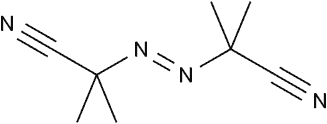
2,2'-Azobis(2-methylpropionitrile)
CAS: 78-67-1
Short Name:AIBN, V-60
Purpose:One of the most commonly used oil-soluble initiators, with a decomposition temperature of about 65℃, is widely applied in the synthesis of general-purpose plastics and rubbers.
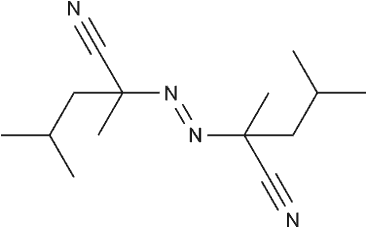
2,2'-Azobis(2,4dimethylvaleronitrile)
CAS:4419-11-8
Short Name:V-65/ABVN
Purpose:It exhibits higher activity and has a lower decomposition temperature (50-65℃), making it suitable for polymerization reactions that require low-temperature initiation
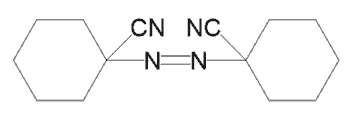
1,1-Azodi(hexahydrobenzonitrile)
CAS:2094-98-6
Short Name:V-40/ACCN
Purpose:Primarily used as a polymer initiator to initiate radical reactions
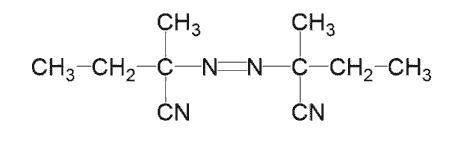
2,2'-Azodi(2-methylbutyronitrile)
CAS:13472-08-7
Short Name:V-59/AMBN
Purpose:Used as a polymerization initiator for vinyl compounds
Core Product Portfolio
AIBN (V-60)
CAS: 78-67-1
Most common oil-soluble initiator with 65°C decomposition temperature. Widely used in general-purpose plastics and rubber synthesis.
10h Half-Life Temp: 65°C | Solubility: Toluene, Methanol
ABVN (V-65)
CAS: 4419-11-8
Higher activity initiator with 50-65°C decomposition range. Ideal for low-temperature polymerization requiring precise initiation control.
Lower decomposition temperature for specialized applications
ACCN (V-40)
CAS: 2094-98-6
Specialized initiator primarily used for radical polymerization reactions requiring specific decomposition characteristics.
10h Half-Life Temp: 88°C | Solubility: Toluene, Organic Solvents
AMBN (V-59)
CAS: 13472-08-7
Polymerization initiator for vinyl compounds with 67°C decomposition temperature. Suitable for aromatic hydrocarbon systems.
Solubility: Aromatic Hydrocarbons, Acetone
Applications in Polymer Manufacturing
PVC Production
As an oil-soluble initiator, it provides the initial free radical in radical polymerization reactions, initiating the chain growth reaction of vinyl chloride monomer.Azobisisobutyronitrile (AIBN) and azobis(2-amidinopropionitrile) (ABVN) are commonly used varieties in suspension polymerization and microsuspension polymerization.
The decomposition process is smooth, mainly producing nitrogen with few side reactions, which helps to generate PVC resin with a relatively uniform molecular weight distribution. It is mainly used in suspension polymerization (the most important production process of PVC) and microsuspension polymerization (for producing PVC paste resin)
Polyethylene (PE) Synthesis
Azo initiators are primarily used as initiators for radical polymerization in the synthesis of polyethylene.
Azobisisobutyronitrile (AIBN) is one of the commonly used varieties.
The decomposition reaction is smooth, basically producing only one type of free radical, with few side reactions, which are easy to control, making it suitable for research on polymer synthesis.
Azo-based initiators such as AIBN are more commonly used in some low-temperature solution polymerizations or specific research scenarios due to their decomposition temperature characteristics.
Acrylic Resins
As an oil-soluble initiator, it decomposes under heating conditions to generate free radicals, which initiate the radical polymerization of monomers such as acrylate and methacrylate.
Azobisisobutyronitrile (AIBN) is the most representative variety, and azobisisobutyronitrile (ABVN) is also used.
The decomposition method is simple, with fewer side reactions, resulting in a narrower molecular weight distribution and a more regular structure of the obtained polymer.
The decomposition products do not contain oxygen, which makes them less prone to cause the polymer to oxidize and turn yellow, helping the resin maintain a lighter color and better outdoor durability. Storage and handling are relatively safer. It is mainly used in solution polymerization and bulk polymerization processes and is a common choice for synthesizing thermoplastic acrylic resins
Trust and Credibility
At Azo Initiators, we specialize in providing high-purity azo initiators designed to enhance polymerization processes across various industries. Our commitment to quality ensures that each product meets stringent standards for performance and safety.
Download Technical Data Sheets
Check the details of our AZOX Azo initiators series products
Frequently Asked Questions (FAQ)
Your Questions, We Value.
What are azo initiators?
What are the benefits of using V-Series azo initiators?
Are your products cyanide-free?
What technical specifications differentiate your azo initiators?
How do you ensure polymerization yield stability?
Contact Us
We'd love to hear from you. Your inquiries are important to us.
No. 66, Zhongrun Avenue, Zhangdian District, Zibo City, Shandong Province,ChiZibo, Shandong, China.+86-15166012761Select...


AZOX Series Initiators
AIBN
ABVN
ACCN
AMBN
About Us
Contact Us